

Choosing between budget and premium tyres can be difficult, especially when the price difference is clear but the performance difference is less obvious. Both types of tyres must meet UK legal safety standards, but they can differ in areas such as wet grip, tread life, road noise, fuel efficiency and driving comfort.
So, are premium tyres worth the extra cost? The answer depends on how and where you drive. If you regularly use motorways, drive in wet weather or cover high mileage, premium tyres may offer benefits that matter to you. If you mainly drive short local journeys at lower speeds, a budget tyre may be a practical option.
In this guide, we compare budget tyres and premium tyres to explain the key differences, including wet weather performance, tyre life, comfort, fuel efficiency and overall value. We will also look at the tyre label and the factors you should consider before choosing tyres for your vehicle.
What Actually Separates Budget and Premium Tyres
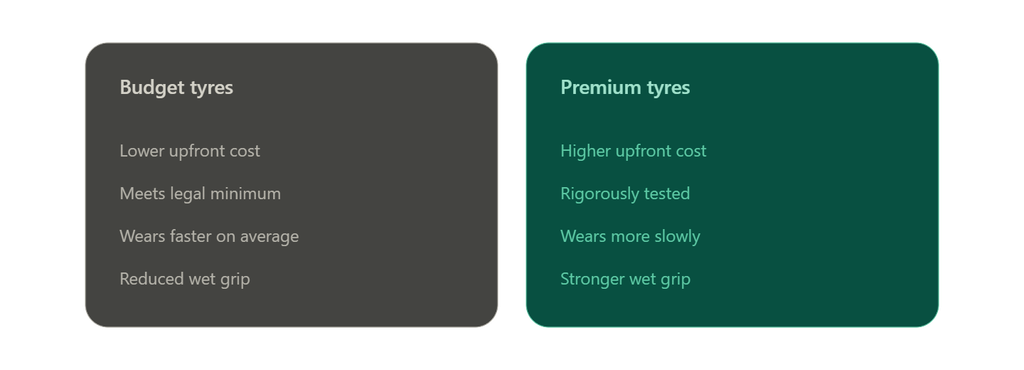
Every tyre sold in the UK must meet a legal minimum safety standard before it can go on sale, which means a budget tyre is never an unsafe or non compliant product simply by virtue of being less expensive. The real difference lies in what happens beyond that legal minimum, in the research, materials, and testing that go into producing a tyre capable of performing consistently across a much wider range of conditions.
Premium manufacturers typically invest heavily in developing rubber compounds and tread patterns specifically engineered to maintain grip as conditions change, whether that means heavy rain, changing temperatures, or high speed cornering. Budget manufacturers generally work within a tighter cost structure, which often means simpler compounds and less extensive testing across the full range of conditions a tyre might realistically encounter.
Understanding the EU Tyre Label
Every tyre sold in the UK carries an EU tyre label, a standardised rating system that offers a genuinely useful, objective way to compare tyres regardless of whether they fall into the budget or premium category. The label rates three specific performance areas, each graded on a scale from A, the best, down to G or E depending on the category.

Wet grip measures how effectively a tyre maintains traction and stopping ability on a wet surface, an area where premium tyres typically achieve higher ratings than budget options. Fuel efficiency reflects a tyre’s rolling resistance, since a tyre requiring less energy to roll contributes to better overall fuel economy. Noise measures the sound a tyre produces at speed, presented as a decibel figure alongside a simple visual sound wave rating.
| Label Category | What It Measures | Why It Matters |
| Wet grip | Braking and traction performance in wet conditions | Directly affects stopping distance and control on wet roads |
| Fuel efficiency | Rolling resistance of the tyre | Contributes to overall fuel consumption |
| Noise | Sound produced at speed | Affects cabin comfort and, in some cases, local noise regulations |
Checking this label before purchasing any tyre, regardless of price point, offers a genuinely objective way to compare options, since it is independently regulated rather than based on marketing claims from any individual manufacturer.
Wet Weather Performance: Where the Gap Matters Most
Of all the differences between budget and premium tyres, wet weather performance is consistently the area where the gap is most pronounced, and arguably where it matters most given how frequently UK drivers encounter wet roads throughout the year. Independent testing has repeatedly shown that tyres rated more highly for wet grip on the EU label produce noticeably shorter stopping distances at higher speeds in wet conditions compared to lower rated alternatives.
The practical difference this represents is not a small margin. Each step down in wet grip rating tends to add a meaningful amount to stopping distance under hard braking, and across the full range from a top rated tyre to a lower rated one, this can add up to the equivalent of several extra car lengths before the vehicle comes to a complete stop. In an emergency braking situation, this margin can represent the difference between stopping safely and a genuinely dangerous outcome.
| Driving Scenario | Where Wet Grip Difference Matters Most |
| Emergency braking on a wet motorway | Longer stopping distance directly increases collision risk |
| Cornering in heavy rain | Reduced grip increases risk of losing control |
| Standing water on rural roads | Higher quality tread patterns reduce aquaplaning risk |
| Wet school run or commute | Consistent grip matters for predictable, everyday stopping |
Tread Wear and Longevity
Beyond wet weather performance, tread wear rate is another area where budget and premium tyres commonly diverge. Premium tyres, built using more advanced rubber compounds specifically engineered for durability, generally maintain their tread depth over a longer distance compared to budget alternatives constructed with simpler materials.
This matters beyond simply how often tyres need replacing. A tyre that wears more quickly also loses its optimal wet grip performance sooner, since much of a tyre’s grip advantage depends on tread depth remaining above a certain threshold. This means a budget tyre’s wet weather disadvantage, already present when new, can widen further as the tyre wears, particularly for drivers covering higher annual mileage.
Noise and Ride Comfort
While less directly tied to safety than wet grip, noise and general ride comfort still meaningfully affect the everyday driving experience, particularly on longer journeys. Premium tyres are generally engineered with tread patterns specifically designed to reduce road noise entering the cabin, alongside construction techniques aimed at absorbing vibration more effectively than simpler budget constructions typically achieve.
For drivers covering significant motorway mileage, or those who simply value a quieter, smoother cabin environment, this difference can become quite noticeable over time, even if it rarely factors into the initial purchasing decision as heavily as price or grip performance.
Thinking About Total Value, Not Just Purchase Price
It is worth stepping back from comparing budget and premium tyres purely on their initial cost, since this comparison alone tells an incomplete story. A tyre that needs replacing considerably sooner than a longer lasting alternative, while also offering reduced fuel efficiency due to higher rolling resistance, may end up costing more across its effective working life than the higher priced option it was chosen to avoid.
This is not to say budget tyres represent poor value in every situation, since the calculation depends heavily on how a vehicle is actually driven. A driver covering low annual mileage, mostly on familiar local roads, will simply not accumulate enough wear or encounter enough demanding wet weather braking scenarios to feel the performance gap as significantly as a driver covering substantial motorway mileage in all weather conditions.
| Consideration | Favours Budget Tyres | Favours Premium Tyres |
| Annual mileage | Low mileage, infrequent driving | High mileage, frequent long journeys |
| Typical road conditions | Familiar local roads at modest speeds | Motorways, faster A roads, varied conditions |
| Weather exposure | Mostly dry, sheltered driving | Regular wet weather or winter driving |
| Passenger considerations | Solo driving, minimal risk exposure | Regularly carrying children or passengers |
| Vehicle age and use | Older vehicle, shorter expected ownership | Vehicle expected to be kept for many years |
Who Genuinely Benefits from Premium Tyres
Certain driving situations make the performance gap between budget and premium tyres considerably more relevant than others, and recognising which category applies to your own circumstances helps make the decision more straightforward.
- Drivers who regularly cover motorway or faster A road journeys, where higher speed wet braking performance matters considerably
- Anyone regularly driving in poor weather conditions, including heavy rain, standing water, or winter driving
- Drivers who frequently carry passengers, particularly children, where the additional safety margin offers real peace of mind
- Vehicles expected to be kept for several years, where the longer effective lifespan of premium tyres offsets their higher initial cost
- Anyone particularly sensitive to cabin noise or ride comfort during longer journeys
Who Might Reasonably Choose Budget Tyres
There are genuine, sensible circumstances where a budget tyre remains a reasonable choice, provided the decision is made with full awareness of the trade offs involved.
- Drivers covering low annual mileage, mostly on familiar, local roads at modest speeds
- Vehicles nearing the end of their useful life, where a shorter term, lower cost solution makes practical sense
- Situations where a legal, correctly fitted tyre is urgently needed and budget constraints are a genuine, immediate factor
- Drivers who rarely encounter demanding wet weather braking scenarios as part of their typical routine
It is worth being clear that a legal, correctly fitted budget tyre in good condition is always a safer choice than a worn or damaged tyre of any type, regardless of original quality. The comparison in this guide assumes both options are new and correctly fitted, rather than suggesting a worn premium tyre is preferable to a fresh budget one.
Tyres and the Rest of the Vehicle
Tyre choice does not exist in isolation from the rest of a vehicle’s systems, and it is worth understanding how tyre performance connects to other components, particularly suspension. A tyre’s ability to grip the road depends partly on the suspension holding it at the correct angle and maintaining consistent contact throughout its full range of movement, meaning even the best premium tyre cannot fully compensate for worn suspension components affecting how it meets the road.
Choosing the right tyre also depends on matching the specific tyre to the specific vehicle, since size, load rating, and speed rating requirements vary considerably between models. For an example of how this kind of vehicle specific guidance works in practice, this guide to choosing tyres for a Mercedes Benz C Class demonstrates how the general principles covered throughout this guide, wet grip, wear rate, and noise, apply when matched against the specific requirements of a particular vehicle.
Checking Tyres Regardless of Which Type You Choose
Whichever category is chosen, regular checking remains equally important, since even a premium tyre offers no meaningful safety advantage once it has worn down toward the legal minimum tread depth. A quick, regular check of tread depth, pressure, and general condition applies just as much to premium tyres as it does to budget ones, and neither category is a substitute for this ongoing attention.

Comparing wear across all four tyres and flagging anything approaching the point where replacement, or rotation between axles, becomes worthwhile. This routine check matters regardless of which tyre category is fitted, since consistent monitoring is what actually determines whether a tyre continues performing safely throughout its life, far more than the initial choice between budget and premium alone.
If you need new tyres for your vehicle, you can visit our tyre shop in Aldershot for help choosing tyres based on your vehicle, driving needs and budget.
Tyres and Your MOT
Tyre condition is one of the most closely inspected areas during an MOT test, and the legal requirements apply identically regardless of whether a budget or premium tyre is fitted. Tread depth must meet the legal minimum across the central three quarters of the tyre, and the tyre must be free from cuts, bulges, or other structural damage, with no distinction made based on the tyre’s original price point or manufacturer.
Booking a check ahead of a scheduled MOT test in Aldershot gives an opportunity to assess tyre condition properly before the test itself, regardless of which category of tyre is currently fitted, ensuring any developing wear is caught with enough time to address it before it results in an unexpected failure.
A Practical Approach to Deciding
Rather than treating this as a simple either or decision, it is worth considering a slightly more nuanced approach. Many drivers find a reasonable middle ground by fitting premium tyres to the front axle, where steering and the majority of braking force are concentrated, while considering a more budget conscious option for the rear, particularly on front wheel drive vehicles where rear tyres experience comparatively less demanding conditions.
This approach is not appropriate for every vehicle or driving situation, and matching tyres across an axle remains important for consistent handling, but it illustrates that the decision does not always need to be a single, uniform choice applied identically across all four corners of the vehicle.
How Tyre Age Affects Performance, Regardless of Price
One factor that applies equally to both budget and premium tyres, yet gets far less attention than the initial purchasing decision, is age. Rubber compounds gradually harden and lose flexibility over time, a process that continues regardless of how many miles the tyre has actually covered or how much tread depth remains. This means a tyre sitting in a garage for several years before fitting, or a low mileage vehicle driven only occasionally, can develop age related performance loss even while looking outwardly fine.
This matters considerably for the budget versus premium comparison, because a premium tyre’s performance advantage assumes the rubber compound is still within its effective working life. An ageing premium tyre, several years past its manufacture date, can perform noticeably worse than its original ratings suggest, sometimes falling below the performance of a fresh budget tyre in the same conditions. Every tyre carries a date code moulded into its sidewall, showing the week and year of manufacture, and checking this figure is just as important as checking tread depth, regardless of which category of tyre is fitted.
| Tyre Age | Typical Condition | Relevance to This Guide |
| Under 3 years | Rubber compound performing close to original specification | Premium versus budget performance gap remains as expected |
| 3 to 5 years | Gradual hardening begins, particularly in wet grip performance | Worth closer inspection, especially for premium tyres relied on for their grip advantage |
| Over 5 to 6 years | Noticeable stiffening, increased risk of sidewall cracking | Replacement worth considering even if tread depth appears adequate |
This is a particularly relevant consideration for anyone purchasing tyres based primarily on brand reputation or category, since an ageing premium tyre bought as old stock, or a spare tyre that sat unused for years before being fitted, does not automatically retain the performance advantages associated with that category. Checking the manufacture date at the point of purchase, and periodically thereafter for tyres that see lower annual mileage, ensures the performance difference this guide has focused on actually applies in practice, rather than being undermined by age related wear that price alone cannot prevent.
Common Myths Worth Addressing
Given how much conflicting information circulates around tyre choice, it is worth directly addressing a few persistent misconceptions that can lead drivers toward decisions based on inaccurate assumptions rather than genuine performance considerations.
| Myth | The More Accurate Picture |
| All budget tyres are dangerous | All tyres sold in the UK must meet a legal minimum safety standard, budget tyres included |
| Premium tyres never need checking as often | Age and wear affect all tyres regardless of category, and premium tyres still require regular inspection |
| Tyre appearance alone tells you everything | Visual condition does not reveal age related rubber hardening, which requires checking the date code |
| A more expensive tyre is always the better choice for any driver | Value depends on how the vehicle is actually driven, not purchase price alone |
| Budget tyres are always a false economy | For low mileage, local driving, a budget tyre can represent entirely reasonable value |
Perhaps the most persistent myth worth correcting is the assumption that this decision is purely binary, with one category being universally correct and the other universally wrong. As this guide has shown throughout, the right choice depends on a combination of factors specific to each driver, annual mileage, typical road conditions, weather exposure, and how long the vehicle is likely to be kept, none of which can be answered with a single, one size fits all recommendation. Treating tyre choice as a genuine decision worth thinking through, rather than defaulting to either the cheapest option available or the most expensive one out of caution, remains the most reliable way to end up with tyres genuinely suited to how a vehicle is actually driven.
Conclusion
The choice between budget and premium tyres ultimately comes down to matching the tyre’s performance profile to how a vehicle is actually driven, rather than defaulting to whichever option carries the lowest upfront cost or the strongest reputation. Premium tyres offer a genuine, measurable advantage in wet weather braking, tread longevity, and noise reduction, advantages that matter considerably more for drivers covering high mileage, frequent motorway journeys, or regular wet weather driving.
Budget tyres remain a legitimate, legal choice for lower mileage drivers on familiar local roads, provided the trade offs are understood rather than overlooked.
What matters most, regardless of which category is chosen, is checking the EU tyre label before purchasing, understanding how the specific ratings align with your own driving pattern, and maintaining whichever tyre is fitted through regular checks rather than assuming quality alone guarantees ongoing safety.
The right choice is rarely about spending the most or the least, it is about spending appropriately for the driving you actually do.
Frequently Asked Questions
Are budget tyres unsafe to use?
No. All tyres sold in the UK must meet a legal minimum safety standard, and a correctly fitted, legal budget tyre in good condition is a safe choice, though performance in areas like wet grip is generally lower than premium alternatives.
What is the biggest difference between budget and premium tyres?
Wet weather braking performance is typically the most significant difference, with premium tyres generally achieving noticeably shorter stopping distances in wet conditions compared to lower rated budget alternatives.
How can I compare tyres objectively before buying?
Check the EU tyre label, which rates every tyre sold in the UK on wet grip, fuel efficiency, and noise using an independently regulated scale, offering an objective comparison regardless of price point.
Do premium tyres really last longer than budget tyres?
Generally, yes. Premium tyres are typically built with more advanced compounds designed for durability, meaning they often maintain usable tread depth over a greater distance than budget alternatives.
Is it ever acceptable to mix budget and premium tyres on the same vehicle?
Some drivers fit premium tyres to the front axle and a more budget conscious option to the rear, though tyres should always be matched across the same axle for consistent handling.
Does tyre choice affect my MOT?
The legal requirements for tread depth and tyre condition apply identically regardless of whether a budget or premium tyre is fitted, so neither category offers any advantage or disadvantage specifically for passing an MOT.